
Written By: Emily Pratt, Museum Program Fellow
The Habits of Mind blog series continues with Being Open to Possibilities. Habits of Mind are ways of thinking and being that help children (and adults!) stay curious, creative, and confident. Program Fellow Emily shares how Being Open to Possibilities can be seen throughout the Museum and in special programming, like National Engineers Week. Let’s dive in.
Recently, a child said to me that “why” is her favorite word and that she could even ask it for a hundred years. That’s a really long time! For adults, even a few minutes of repeatedly hearing “why” can feel a bit exhausting especially if you’ve really answered all the possible whys. While the frustration of being caught in a “why” loop might cloud the positive of the situation, we can remind ourselves that there is curiosity beneath all of these “whys”—and that is worth celebrating! Curiosity is the spark for thousands of joyful discoveries, and these discoveries can be witnessed and encouraged throughout Boston Children’s Museum’s exhibits and programs.
Exhibits at Boston Children’s Museum are created to encourage questions and a curious spirit. In Bubbles, a rope dangles invitingly asking to be pulled, hula hoops rest amidst suds, and fog billows beckoningly. Even from Investigate and just outside of Science Playground, you can hear the gasps of excitement and the exclamations of “bubbles!” Once walking through the space, I saw a kid’s face light up as he pulled the rope to what we call the stretch and saw a bubble sheet “stretch” before him. His smile only grew larger as he realized he could blow bubbles through the surface and he happily shared his discovery with a younger kid who was watching this process with curiosity. These joyful discoveries can be seen all throughout the Museum and are also encouraged in Museum programs.

Programs at the Museum also work to foster this openness to possibilities, by encouraging children to test out ideas, ask questions that will lead to new discoveries, and possibly even take things apart to learn more about how something works. National Engineers Week at Boston Children’s Museum is a great example of a program that focuses on curiosity and asking questions. During this week, Museum Educators ran rotating activities centered around questions to inspire building, engineering, and problem solving with a set amount of materials as a constraint. At Boston Children’s Museum, we describe engineers as working with others to solve problems for people, communities, and animals. Through engineering activities, we ask a child to think of what another person might need in a situation and consider the many possibilities of how to best help them. Constraints, such as limited materials, offer a design challenge that mirror challenges professional engineers might face. While each of these activities encourages being curious, asking questions, and testing out ideas, my favorite activity to staff was Circuits.
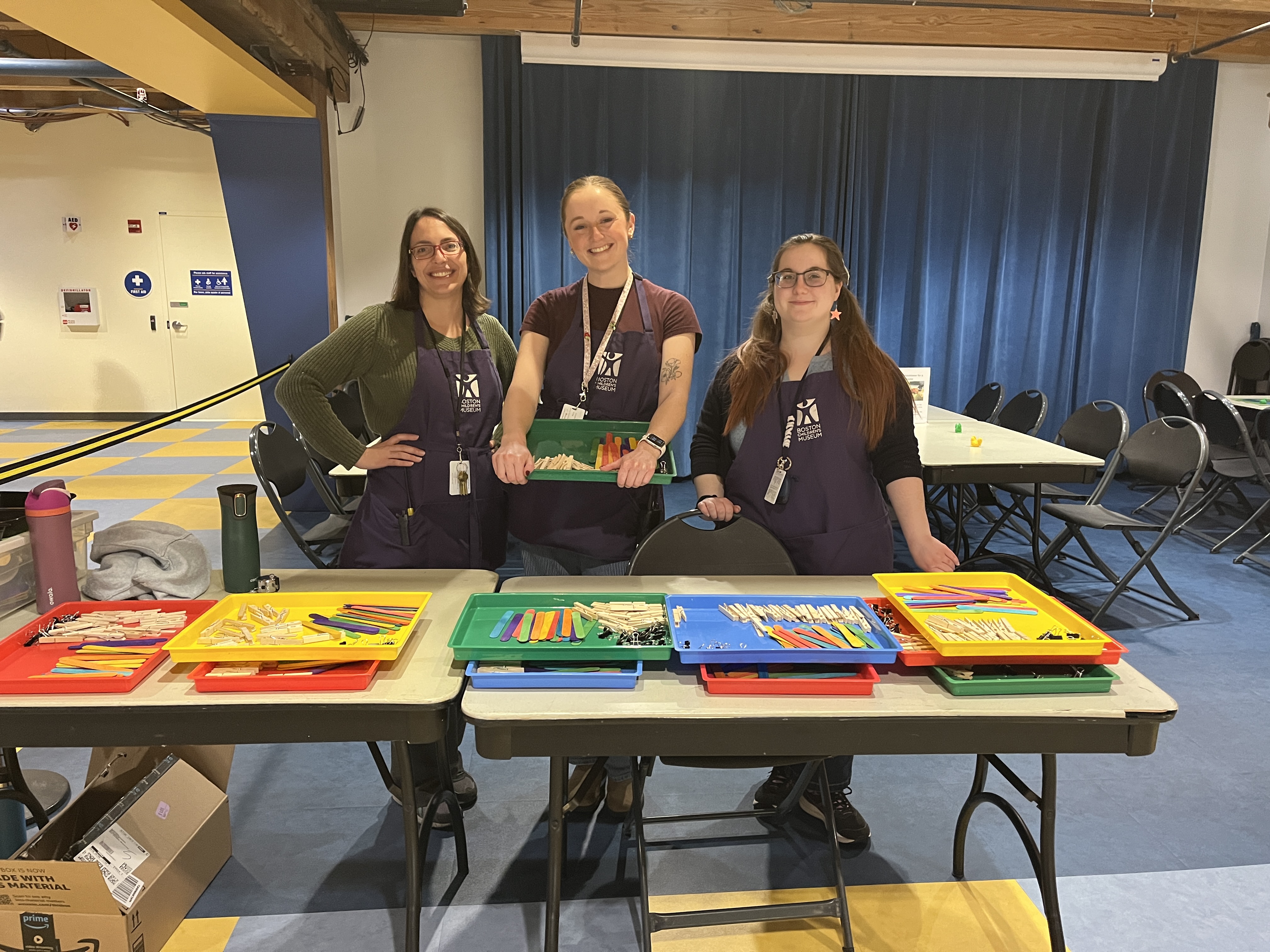

When I was helping with Circuits, I first offered kids a lightbulb or LED light, a battery/power source, and a few alligator clip wires. We asked children to try to connect the components to move the power from the battery to the lightbulb and light it up. I was a physics major in college, so I enjoy getting to share that with the kids. But since I spent many years studying the subject, I had long forgotten the surprise and excitement a simple circuit can provide. I was shocked by the amount of time visitors would spend there. One kid spent their whole time disconnecting and reconnecting the circuits, excited each time to see the light, while another kid became interested in the on/off switches and dimmer switch that I pulled out next and had to try each one in turn (despite the fact they all operate practically the same). Visitors would ask me various questions like: What would happen if I switch the order of components? What would happen if they use an LED light and a lightbulb? How do the on/off switches work? With some of these questions, I would simply say, “Try it, and we can talk about it” or we would experiment together leading to further questions. The only curiosity that I sadly couldn’t allow to be tested was the question of “What would happen if all three batteries were connected in a circuit to one light?” Testing this out with the LED was fine but with the lightbulb, too much voltage flowed through the circuit and it the lightbulb burned out, which I learned the hard way. With only three little lightbulbs in the circuits kit at that moment, I sadly couldn’t risk burning out another lightbulb even if it would have been very fun for the kids.

Curiosity and asking questions take many forms and are not just a part of science and STEM. Being willing to question ideas and to ask “why” is also helpful in building identity and self expression. In the Museum’s Dress to Express program, kids can try on various costumes/outfits, deciding what they like and how they want to express themselves. Similarly, the Art Lab offers monthly activities that are open ended and focus more on learning a technique or exploring a material like water colors rather than creating a specific thing. This helps support the idea that there isn’t just one single way to do art and there isn’t just one way to express oneself—there are endless possibilities. In a recent Art Lab activity called Moving Parts Art, staff gave visitors a rectangular sheet of paper, three brads or paper fasteners and at the table there would be many small shapes to choose from. Many visitors created abstract designs of overlapping geometric shapes, while others created animals, creatures, or scenes. Shapes twisted across the page to form a snake, or my personal favorite; limbs extending from the paper to form the legs of a frog. Some visitors even tried folding their shapes making the piece more 3-dimensional. It was so interesting to witness the different interpretations and explorations of the material and to see visitors uninhibited by the idea that their art had to look one particular way. They were curious about the materials and were able to ask questions like “how else can this material be used?” leading to new ideas and forms of expression.

Now let’s return to the child with the endless “whys.” While it might be difficult to see it as a positive when it never ends, “why” truly is the beginnings of curiosity development for kids. They might not know exactly what they’re asking or how to phrase it yet, but it shows that they are interested. That interest is what eventually sparks deeper questions and also the desire to examine and investigate, to explore and to discover, to test ideas out and take things apart. While these are all important skills to develop in childhood as they are also essential in adulthood, they also lead to so much joy and wonder. We, adults, can learn so much from the ways kids examine and learn, whether it is an openness to ideas and possibilities that we sadly tend to lose over time, or just pure delight at a new discovery.

 The Power of Play